OpenAI’s GPT-6.1 Terra Costs Half as Much as Sol: What to Check
OpenAI’s GPT-6.1 Terra costs $1 per million input tokens and $5 per million output, half of GPT-6.1 Sol. Here is what changed, where it runs and what to test.
Key Takeaways
- OpenAI released GPT-6.1 Terra on Oct. 26, 2026, at $1 per million input tokens and $5 per million output tokens, half the standard price of GPT-6.1 Sol.
- In ChatGPT, the model is available only in Work and Codex on Plus, Pro, Business, Enterprise and Edu plans, not in Chat, and AWS made it generally available on Amazon Bedrock the same day.
- OpenAI’s system card addendum treats GPT-6.1 Terra as Critical in cybersecurity capability under its Preparedness Framework, so it ships with the same safeguards stack as GPT-6.1 Sol and GPT-6 Astra.
In this article
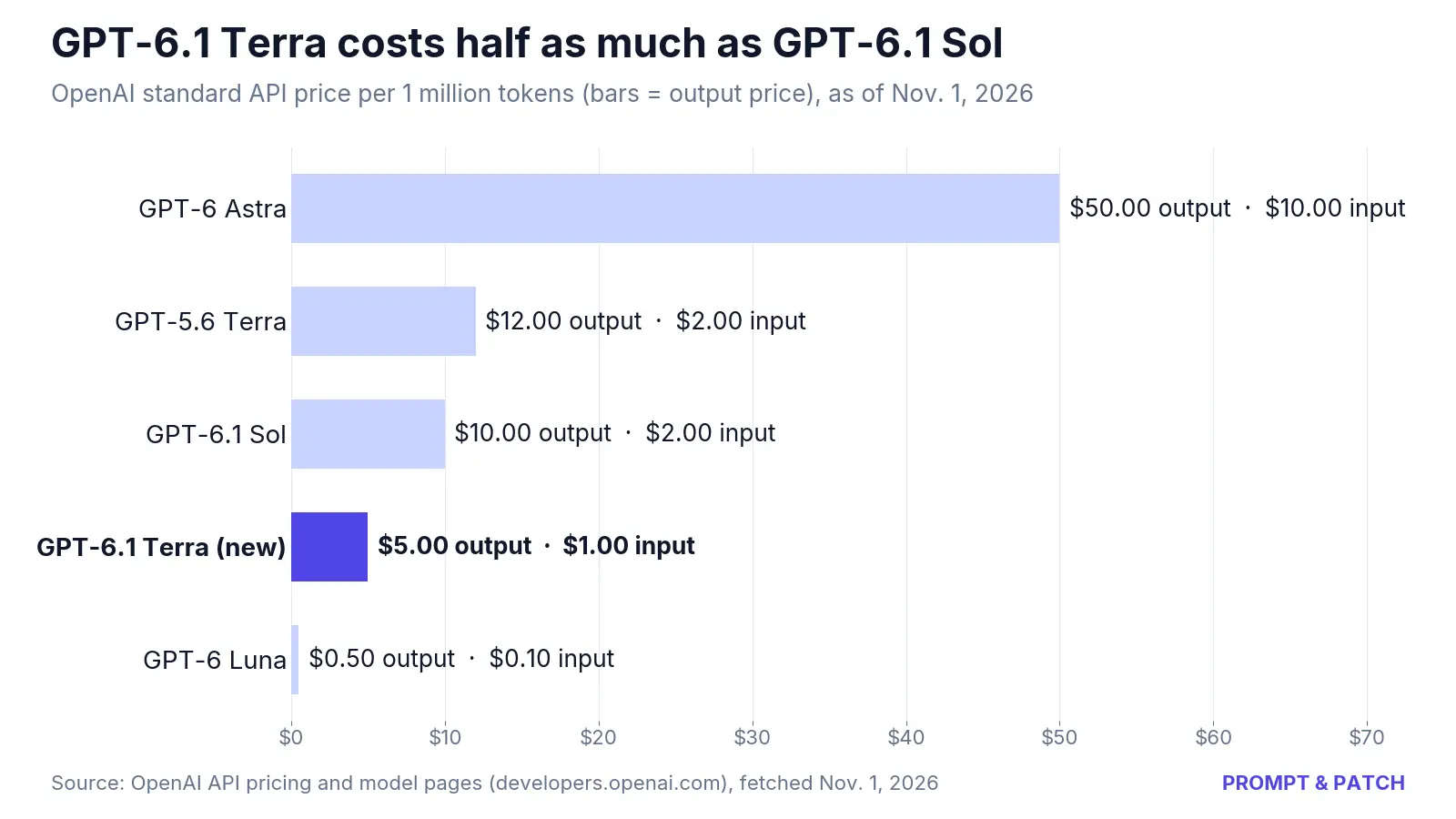
OpenAI released GPT-6.1 Terra on Oct. 26, 2026, a mid-priced model that costs $1 per million input tokens and $5 per million output tokens through its API. That is half the standard price of GPT-6.1 Sol ($2 and $10), and OpenAI describes Terra as “a fast, efficient model for visual reasoning, precise computer use, and clear, natural writing.”
Among the four models OpenAI lists as its current flagships, Terra is now the second-cheapest, above only the budget GPT-6 Luna. It is also showing up in places businesses already buy from: ChatGPT Work, Codex and Amazon Bedrock.
What OpenAI released
GPT-6.1 Terra (model ID gpt-6.1-terra) went live in the API’s Responses and Chat Completions endpoints, according to OpenAI’s API changelog. The model page lists these specs:
- Context window: 1,050,000 tokens, with up to 128,000 output tokens. A token is a chunk of text, roughly part of a word.
- Knowledge cutoff: June 1, 2026. GPT-5.6 Terra’s cutoff is Feb. 16, 2026.
- Inputs: text and images. Output is text only; audio and video are not supported.
- Reasoning effort: none, low, medium (the default), high, xhigh and max.
- Tools: web search, file search, code interpreter, computer use and MCP connections, among others, through the Responses API.
OpenAI suggests uses such as matching product photos to catalog entries, interpreting technical drawings, acting on application screens, and drafting or revising text.
On performance, the main claim comes from AWS’s launch note, which cites OpenAI’s own testing: in OpenAI’s Agents’ Last Exam evaluation, Terra scored 15 percentage points higher than GPT-5.6 Terra, performed on par with GPT-6 Astra, and finished tasks more than three times faster than Astra and GPT-6.1 Sol. These are vendor results, not independent ones.
Where you can use it
API: available on the Build, Launch and Grow usage tiers; the Free tier is not supported. Rate limits start at 5,000 requests and 1 million tokens per minute on the Build tier and rise to 15,000 requests and 40 million tokens per minute on Grow, according to the model page.
ChatGPT and Codex: OpenAI’s Codex changelog says Terra is available in ChatGPT Work and Codex on Plus, Pro, Business, Enterprise and Edu plans. Work also supports it on mobile. The model “isn’t available in Chat” and does not support UAE inference residency. For Enterprise, access depends on workspace availability and administrator controls.
Amazon Bedrock: AWS announced general availability on Bedrock the same day. AWS says customers can call Terra through Bedrock APIs or configure ChatGPT Work and Codex to use the model on Bedrock. AWS says its established controls can be used to secure workloads, govern access and audit model calls.
What it means for your team
The biggest change is cost. Here is how Terra compares with OpenAI’s other current models at standard prices, per million tokens:
| Model | Input | Cached input | Output | Example month* |
|---|---|---|---|---|
| GPT-6 Astra | $10.00 | $1.00 | $50.00 | $55,000 |
| GPT-6.1 Sol | $2.00 | $0.10 | $10.00 | $11,000 |
| GPT-5.6 Terra | $2.00 | $0.20 | $12.00 | $12,000 |
| GPT-6.1 Terra | $1.00 | $0.05 | $5.00 | $5,500 |
| GPT-6 Luna | $0.10 | $0.01 | $0.50 | $550 |
*Illustration only: 1 million requests a month, each with 3,000 input tokens and 500 output tokens, no caching. Prices from OpenAI’s pricing and model pages on Nov. 1, 2026.
The math for Terra: 1 million requests × 3,000 tokens = 3 billion input tokens, or 3,000 million × $1 = $3,000. Output is 500 million tokens × $5 per million = $2,500. Total: $5,500 a month, versus $12,000 for the same workload on GPT-5.6 Terra.
Three pricing rules can move that number a lot:
- Caching. Cached input costs $0.05 per million, 5% of the normal rate. If 2,000 of the 3,000 input tokens in each request are a repeated system prompt, the example drops to about $3,600 ($100 cached + $1,000 uncached + $2,500 output), before cache-write charges of $1.25 per million tokens for 30-minute retention.
- Batch and Flex. Work that can wait gets 50% off, so the example would cost $2,750.
- Surcharges. Prompts over 272,000 input tokens are billed at 2x the input and cache rates and 1.5x output for the whole request. Regional processing (data residency) adds 10% where available, and OpenAI’s pricing page says FedRAMP endpoints also carry a 10% uplift starting Nov. 1, 2026.
Tool calls cost extra. Web search, for example, is listed at $10 per 1,000 calls. For a deeper primer on how these line items add up, see how AI API pricing works.
What to check before switching
OpenAI’s GPT-6 guide gives specific migration advice. Use it as a test plan:
- Run a side-by-side test. OpenAI recommends comparing GPT-5.6 Terra and GPT-6.1 Terra “on representative images and workflows using the same reasoning effort.” Use your own prompts and score the outputs, as covered in how to evaluate an AI tool for business.
- Move tool calls to the Responses API. Terra works in Chat Completions, but tool calling requires Responses.
- Tune reasoning effort. OpenAI says to start at medium and raise it only if the quality gain “is worth the added time and tokens.” Since extra effort costs tokens, track real token counts in your tests, not just list prices.
- Check data residency. Fast mode supports EU data residency for Terra, according to OpenAI. If you need residency in a specific region, confirm it before you commit.
- Plan for no fine-tuning. The model page lists fine-tuning as not supported.
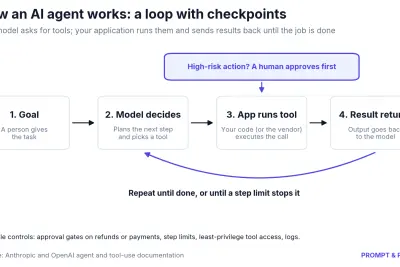
- Review agent permissions. Terra is pitched for computer use, meaning it can act on screens and apps. If you use it for agentic AI workflows, limit what accounts and systems it can reach.
What the safety card says
OpenAI published a system card addendum for Terra on its Deployment Safety Hub. Under its Preparedness Framework, OpenAI says it is treating GPT-6.1 Terra as Critical in cybersecurity capability and High for biological and chemical capability. As a result, Terra uses the same safeguards stack as GPT-6.1 Sol and GPT-6 Astra.
On OpenAI’s Production Benchmarks for challenging prompts, the company says Terra performs on par with GPT-5.6 Terra. On tests that combine text and images, OpenAI reports a statistically significant regression in hate and extremism. It says manual review and its other evaluations found performance in line with prior launches.
What to watch next
- Dec. 11, 2026: OpenAI’s deprecations page lists this shutdown date for
gpt-5-mini, withgpt-5.6-terraas the recommended replacement. Teams on that older model will have to migrate, and Terra is now a second option to test. - Rollout in Enterprise workspaces: access depends on administrator controls, so IT teams may see requests to enable the model.
- Independent results: the Agents’ Last Exam figures come from OpenAI. Third-party evaluations, if published, would give buyers a second view.
Sources
- OpenAI API — Changelog (entry of Oct. 26, 2026)
- OpenAI API — GPT-6.1 Terra Model
- OpenAI API — Pricing
- OpenAI API — Models
- OpenAI API — Using GPT-6
- OpenAI API — GPT-5.6 Terra Model
- OpenAI API — Deprecations
- OpenAI Deployment Safety Hub — Addendum to GPT-6 Astra System Card: GPT-6.1 Terra
- OpenAI Codex — Changelog (GPT-6.1 Terra in Work and Codex, Oct. 26, 2026)
- AWS What’s New — OpenAI GPT-6.1 Terra is now generally available on Amazon Bedrock (Oct. 26, 2026)